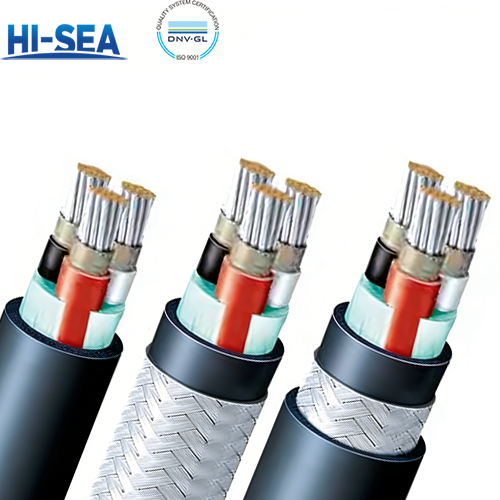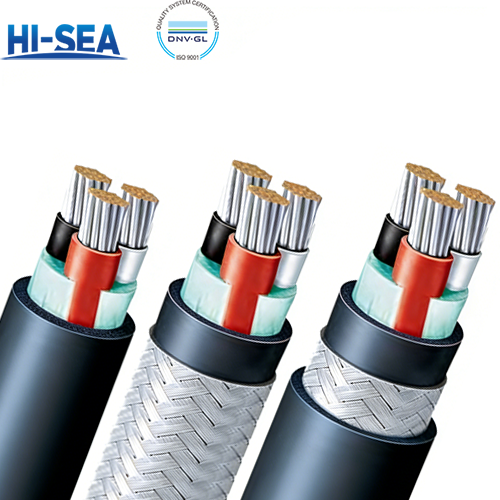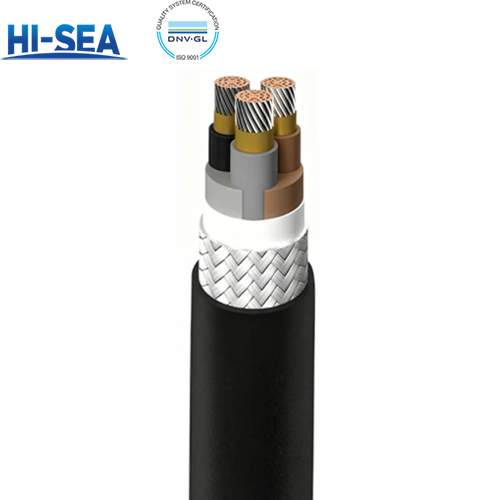
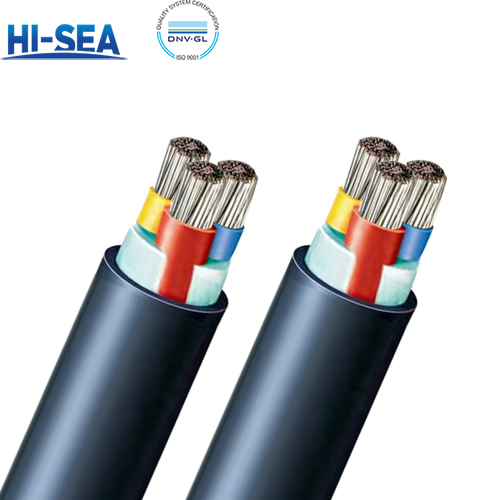
EPR Insulated Flame Retardant Shipboard Flexible Power Cable
Our 0.6/1kV EPR Insulated Flame Retardant Shipboard Flexible Power Cables are designed for power transmission, lighting, and general control applications on marine vessels, offshore platforms, and industrial facilities including metallurgical plants, chemical works, and power stations.
Featuring Class 5 flexible tinned copper conductors combined with EPR (Ethylene Propylene Rubber) insulation, these cables provide exceptional flexibility for installations requiring frequent bending, tight routing, and easy handling in confined spaces.
Overview
1. Core Technical Features
Parameter | Specification | Standard |
Rated Voltage | 0.6/1 kV | IEC 60092-350 |
Conductor | Stranded tinned annealed copper, Class 5 (flexible) | IEC 60228 |
Insulation | EPR (Ethylene Propylene Rubber) | IEC 60092-351 |
Sheath | SHF1 (thermoplastic) or SHF2 (thermoset) | IEC 60092-360 |
Normal Operating Temp | Up to 90°C | – |
Short Circuit Temp | Up to 250°C (max 5s) | – |
Flame Retardancy | Category A | IEC 60332-3-22 |
Low Smoke | Light transmittance ≥ 60% | IEC 61034 |
Halogen-Free | Halogen acid gas < 5 mg/g, pH ≥ 4.3 | IEC 60754 |
2. EPR vs. XLPE: Why Flexibility Matters
Property | EPR | XLPE |
Flexibility | Excellent – 40% lower bending force vs. XLPE | Moderate – stiffer material |
Moisture Resistance | Superior – 30% better moisture barrier vs. XLPE-; insulation resistance drop <10% in humid environments | Good |
Chemical Resistance | Excellent resistance to oil, solvents, and seawater | Moderate |
Low-Temperature Performance | Superior down to -45°C | Good down to -40°C |
Bending Radius | ≥4D (D: cable diameter) – suitable for tight spaces | ≥6D |
Typical Application | Flexible installations, vibration-prone areas, confined cable trays | Fixed installations |
EPR insulation provides 40% better flexibility than XLPE, enabling easier routing in confined shipboard spaces.
3. Class 5 Flexible Conductor Advantage
IEC 60228 Class 5 conductors use fine-stranded tinned copper wires, offering:
Feature | Benefit |
Fine-stranded construction | Exceptional bending capability – ideal for cable trays, conduits, and tight spaces |
Tinned copper | Superior corrosion resistance in marine saltwater environments |
Easy handling | Reduced installation time and labor costs |
Vibration resistance | Reliable performance in engine rooms and machinery spaces |
4. Flame Retardancy Performance
Our EPR flexible cables meet IEC 60332-3-22 Category A flame retardancy requirements:
Test duration: 40 minutes of flame application
Flame temperature: 750°C
Pass criteria: Carbonization height does not exceed 2.5m
This ensures the cable will not propagate fire along its length in bunched installations.
5. Why Choose Our EPR Flexible Cables?
Superior Flexibility – Class 5 fine-stranded conductors provide exceptional bending performance, reducing installation time and complexity in tight spaces. EPR insulation further enhances flexibility compared to XLPE.
High Safety – Low smoke, zero halogen, Category A flame retardant – minimizes toxic fumes and maintains visibility during fire emergencies.
Durable Marine Construction – Tinned copper conductor resists corrosion in saltwater environments; EPR insulation provides excellent moisture and chemical resistance.
Material Flexibility – Choose between SHF1 (thermoplastic, economical) and SHF2 (thermoset, high oil/UV resistance) sheaths based on environmental requirements.
Wide Application Range – Suitable for interior cable trays, control panels, engine rooms, decks, and offshore platforms.
International Compliance – Manufactured to IEC standards (IEC 60092-350, -351, -353, -360, IEC 60332-3-22, IEC 60754, IEC 61034) for global marine and offshore projects.
6. Industry Standards & Compliance
Standard | Description |
IEC 60092-350 | General constructional requirements and test methods for shipboard cables |
IEC 60092-351 | Insulating materials (EPR specifications) |
IEC 60092-353 | Power cables rated 1 kV and 3 kV |
IEC 60092-360 | Insulating and sheathing materials (SHF1, SHF2, EPR) |
IEC 60332-3-22 | Category A flame retardancy (bunched cables) |
IEC 60754 | Halogen gas emission test (halogen-free compliance) |
IEC 61034 | Smoke density test (low smoke compliance) |