

1. Applicable International Standards
IEC 60228, Conductors of insulated cables
Specifies core conductor parameters: material, construction, nominal cross-section area, number of strands, and DC resistance.
IEC 60092 series, Electrical installations in ships
Builds upon IEC 60228 and imposes stricter requirements for marine environments (salt spray resistance, humidity resistance, vibration resistance, etc.).
Key Indicator: The 20°C DC resistance of the conductor must comply with IEC 60228, it is the primary quality criterion for electrical conductivity.
2. Common Conductor Class: Class 2 vs. Class 5
Marine cable conductors are classified mainly as Class 2 and Class 5 by flexibility, for different installation conditions:
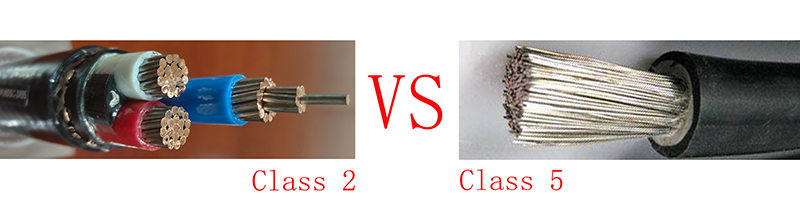
Comparison Item | Class 2 Conductor | Class 5 Conductor |
Common Name | Stranded Conductor | Flexible Conductor |
Material Type | Bare / Tinned copper wire, regular lay stranded | Fine copper wires, bunched then stranded |
Flexibility | Moderate (relatively rigid) | Excellent |
Installation | Fixed installation | Frequent bending / high flexibility required |
Tensile Strength | High | Moderate |
Bending Durability | Moderate | Excellent |
Typical Applications | Engine room main circuits, bulkhead fixed conduits, fixed wiring between main and distribution switchboards | Flexible connections between marine equipment and sockets, high-vibration zones such as engine rooms |
3. Why Choose Copper for Marine Conductors
Copper is the primary conductor material for marine cables, with outstanding properties:
High electrical conductivity: Second only to silver, ensuring high current-carrying capability.
High mechanical strength: Tensile strength of 200–300 MPa, excellent resistance to vibration and impact.
Good solderability and connectivity: Reliable joints for easy site termination.
Excellent ductility: Easily drawn into fine wires for stranding.
For ship electrical systems requiring high safety integrity (main power, emergency fire protection, control signals, etc.), copper conductors are the preferred choice approved by all classification societies.
4. Surface Coating: Why Marine Copper Conductors Must Be Tinned
Bare copper is prone to corrosion in high-humidity, salt-laden offshore environments. Therefore, marine copper conductors must be tinned, the tin layer serves as a corrosion-resistant barrier for the copper core.
Advantages of Tinned Copper Conductors
Superior salt spray corrosion resistance: The tinned layer protects the underlying copper from marine salt spray and sulfide attack.
Excellent solderability: Facilitates reliable soldering of cable joints and terminals.
Moderate temperature resistance: When matched with suitable insulation, it meets marine cable operating temperatures of −20°C to 90°C.
Compliant International standard: IEC 60092-350 mandates tinned copper conductors for marine cables, Where thermosetting insulation is used, the copper wires shall have a metal coating unless a separating layer is provided between the conductor and the insulation. For conductors with thermoplastic insulation, the metal coating may be omitted.
Distinct appearance: Silvery-bright surface for easy identification.
5. Selection Guide
Application | Recommended Conductor | Remarks |
Main power cables, fixed installation | Tinned copper, Class 2 (stranded) | Main trunk circuits requiring high mechanical strength |
Control & instrument cables | Tinned copper, Class 5 (flexible) | Moderate flexibility for easy installation |
Frequently moving equipment | Tinned copper, Class 5 (flexible) | High flexibility required |
Communication & signal cables | Tinned copper, Class 5 (flexible) | Flexible, with shielding for noise immunity |
6. Summary
The core principles for marine cable conductor selection are:
Material: Copper is the mainstream choice with unmatched overall performance.
Surface treatment: Tinned copper conductor is the standard finish, providing essential corrosion protection.
Construction: Class 2 for fixed installation; Class 5 for mobile or high-flexibility applications.
As a professional marine cable supplier, we deliver cables with tinned copper conductors complying with IEC 60228, IEC 60092, and major classification society approvals, covering Class 2 and Class 5 conductors. Our products meet diverse project requirements for fixed installation and flexible connections. Please contact us for technical support and selection advice.